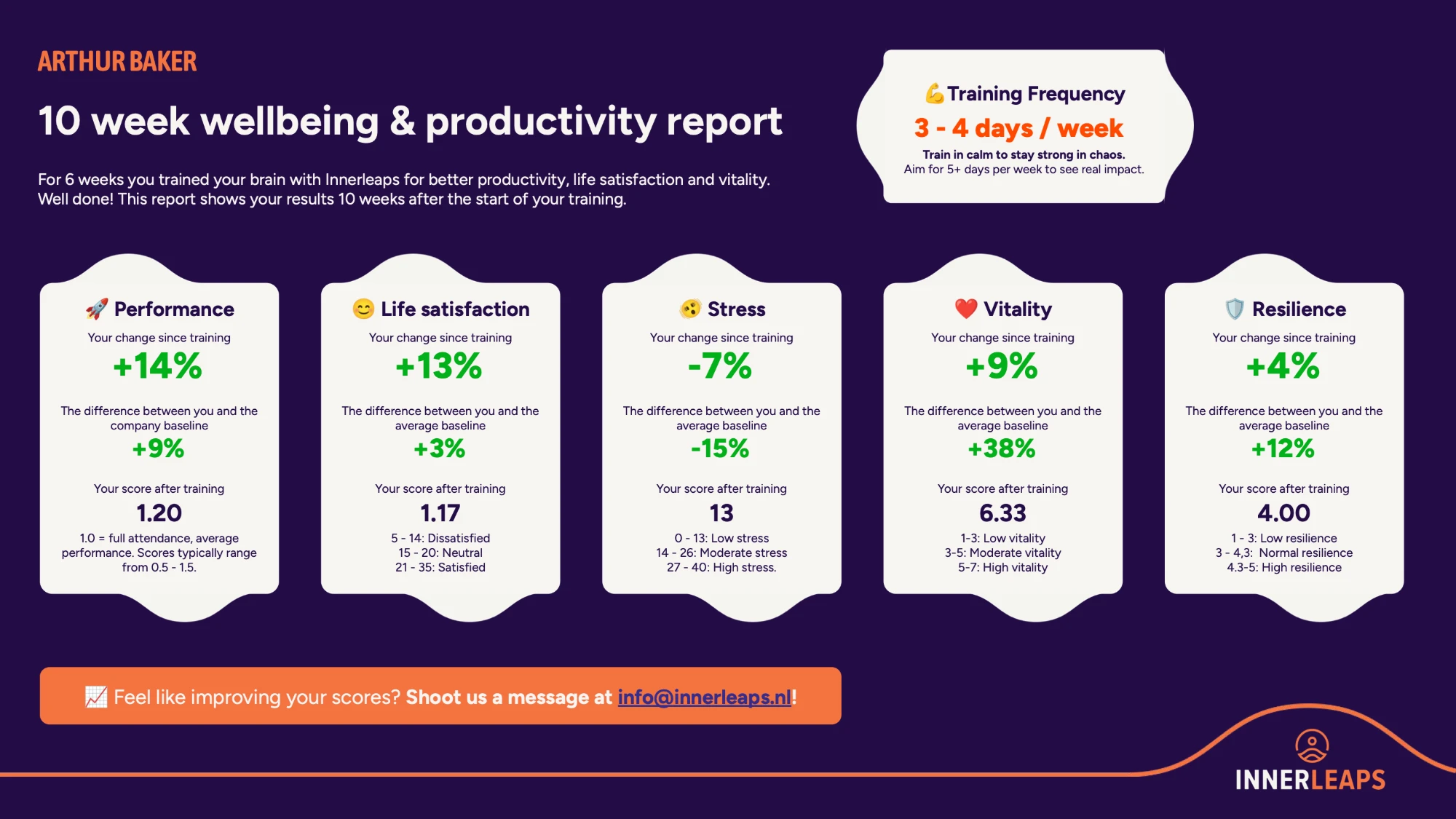
Case study: TheyDo
8.6% more productive and 7 in 10 feel less stress
TheyDo works fully remote, with lots of freedom. That leaves little visibility into how the team works. 39 colleagues took part and trained their attention for six weeks.

“You're enabling people to get more out of their workday without working more hours.”
Results
+8.6%
productivity 4 weeks after training
Randomised research points the same way (Michaelsen et al., 2023).
68%
feel less stress and tension
9.3
for the trainers, 8.1 for the programme
Question for Jochem
What was going on at TheyDo?
“We're a remote organisation with employees in 26 countries. We're seeing them on screen time, but outside of it, we don't know.”
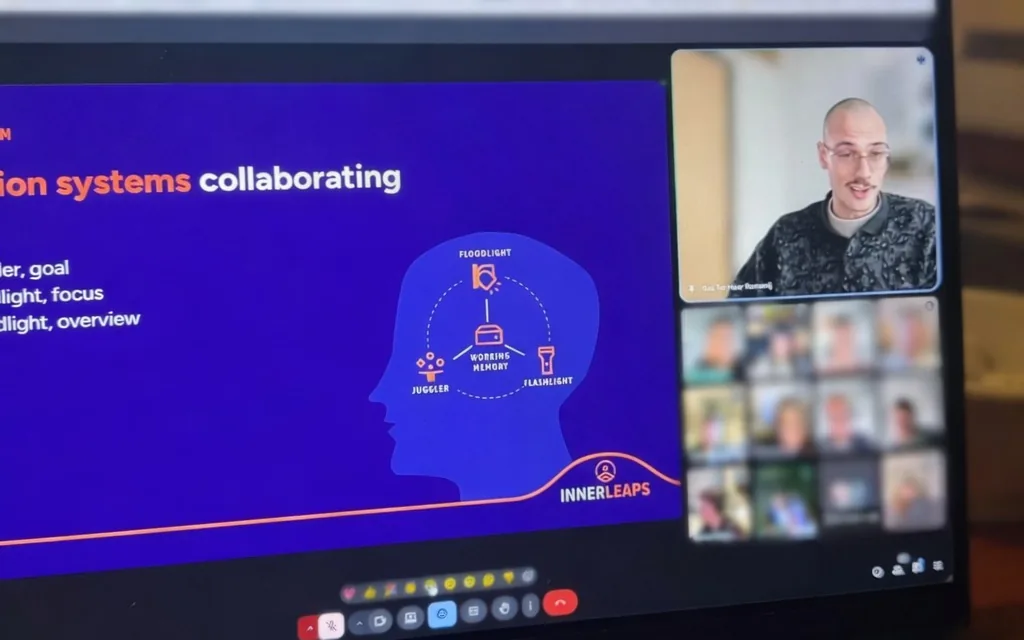
At a glance
- Company
- TheyDo, journey management software for large enterprises
- Team
- Fully remote, across 26 countries
- Participants
- 39 employees, about 40% of the company, signed up voluntarily
- Programme
- Six weeks of Innerleaps brain training, online, March to April 2026
- Measured
- Before the training and four weeks after it, plus an evaluation at the end of the training
Question for Jochem
What were your doubts before you started?
“It could be seen as a sign of weakness. I wasn't sure how our employees would respond. It could be backfiring. But in the end, it didn't.”
39 people signed up voluntarily after the masterclass. About 40% of the company.
Why did it work? Jochem presented it as maintenance, not repair.
Question for Jochem
What did you notice in your colleagues?
“A coworker just blurted out: it's so great, I'm actually sleeping again. That's not something you talk about at work.”
22 of the 39 participants filled in an evaluation at the end. These came up most:
- Less stress and tension68%
- Less running on autopilot55%
- Less mental fatigue55%
- Better concentration and focus41%
What participants say
“This has been very helpful to improve both work and life outside of work.”
“I now recognise when I'm stressed, and how to do something about it.”
“My biggest insight is that short exercises can increase my focus and wellbeing.”
Question for Jochem
Was it worth the investment?
“It's a hell yes. In our sales team, 8.6% literally turns into more meetings, more qualified prospects and ultimately more revenue.”
23x
At TheyDo, the programme paid for itself from a productivity gain of 0.36%. The measured gain was 8.6%: more than 23 times as much. Where your break-even sits depends on your salaries and number of participants. .
Question for Heidi
How much work was it for HR?
“You guys were super organised. You had all the materials ready. You told me exactly what to do and when to do it. So I think it was a very easy collaboration, for sure.”

Bonus result
Colleagues who normally don't work together got to know each other properly.
Question for Heidi
What could have been better?
“People are enjoying this, but it would have been good to have a heads-up before the first session that we needed to be in a quiet space.”
What we changed
- We now say upfront that you'll need a quiet spot
- The workbook arrives week by week, not in one go
- English audio re-recorded by a native speaker
- A daily nudge in your own chat app
Question for Jochem
Would you do it again?
“I would definitely do this again. It's something you can do throughout the year, again with your new employees, and keep doing as the company grows.”
How long do the effects last?
Scientific research shows that participants still feel less stress up to a year after the training (Michaelsen et al., 2023). Longer than that has hardly been studied.
How did we measure the impact?
- We measured productivity with the World Health Organization's Health and Work Performance Questionnaire (HPQ). Participants are asked to rate their own work performance over the past four weeks. We measured it with 20 participants, once before the training and again four weeks after it ended. The result is an 8.6% increase in productivity.
- Randomised research shows the same: after similar training, participants perform better at work than a comparison group (Michaelsen et al., 2023).
- People who practised more than once a week did even better: their productivity rose by 11.1%.
- Every participant got their own impact report. Individual answers never go to the employer.